What if that orange DOT notice on your door isn’t just a repair request, but a high-stakes invoice waiting to happen? Receiving a sidewalk violation often feels like an immediate weight on your shoulders, especially with the 75-day countdown already ticking. You’re likely concerned about hidden administrative fees, complex city specifications, and the looming threat of a property lien. Understanding the sidewalk violation costs is the first step toward regaining control and protecting your investment from the city’s aggressive repair billing.
We understand that maintaining a New York property requires a balance of technical precision and financial foresight. It’s easy to feel overwhelmed by the pressure of inspections or the fear of expensive, city-imposed contractors who may not prioritize your property’s long-term value. This guide provides a methodical breakdown of the real-world factors that determine your total expenses, from DOT permit fees to the specific square footage of your concrete flags. You’ll discover how to secure a violation-free title and ensure your repairs are durable enough to pass the most rigorous city inspections. By following this 2026 pricing guide, you can replace uncertainty with a clear, compliant path forward.
Key Takeaways
- Act within the 75-day window to maintain full control over your repair process and avoid non-negotiable city billing.
- Learn how variables like concrete square footage and permit fees influence the total cost to remove sidewalk violation NYC.
- Discover why hiring a private, licensed contractor provides superior material quality and lower overhead compared to city-assigned crews.
- Follow a methodical four-step roadmap to ensure your property’s new sidewalk flags meet all current DOT specifications for a successful dismissal.
Received a DOT Sidewalk Violation? Understanding Your 75-Day Window
The NYC Administrative Code makes it clear: the sidewalk in front of your property falls under your sidewalk maintenance responsibilities. This isn’t just a suggestion; it’s a mandate that has evolved significantly through the history of sidewalk liability in the five boroughs. When the Department of Transportation (DOT) issues a notice, they’re informing you that your property’s exterior fails to meet safety standards. You have exactly 75 days from the date of that notice to complete repairs. This window is the most critical period for your finances. It represents the only time you have full control over the cost to remove sidewalk violation NYC. Once those 75 days pass, the city can step in, hire their own contractors, and send you a bill that’s often much higher than a private quote.
Understanding the distinction between city agencies is vital. A DOT violation focuses specifically on the public walkway’s safety and accessibility. In contrast, a Department of Buildings (DOB) violation usually concerns the structure itself or construction permits. While both are serious, a DOT sidewalk notice is a direct countdown. If you act within this timeframe, you choose the materials, the contractor, and the schedule. This allows for a more methodical approach to restoration rather than a rushed, city-mandated fix.
What Constitutes a ‘Hazardous’ Sidewalk in NYC?
The DOT doesn’t issue violations for minor cosmetic flaws. They look for specific structural failures that pose a risk to pedestrians. A primary trigger is a vertical grade change of 1/2 inch or more between sidewalk flags. These trip hazards are the most common reason for a notice. Additionally, any hardware trip hazards or holes larger than 1 inch in diameter will catch an inspector’s eye. More severe conditions, like collapsed flags or “undermined” sections where voids exist beneath the concrete surface, require immediate attention to prevent the cost to remove sidewalk violation NYC from escalating due to emergency repair rates.
The Consequences of Ignoring the 75-Day Deadline
Missing the deadline changes your status from a proactive owner to a passive recipient of city services. On day 76, the city gains the authority to perform the work using their own pre-selected crews. You won’t have a say in the craftsmanship or the final price. The resulting bill often includes significant administrative overhead and non-negotiable labor rates. If this bill goes unpaid, the city places a lien on your property title, which complicates any future sale or refinancing. Beyond the financial sting, an open violation can lead to increased insurance premiums. It also leaves you vulnerable to personal liability in slip-and-fall lawsuits, as the violation serves as documented proof of a known hazard.
Calculating the Cost to Remove Sidewalk Violation NYC in 2026
Pricing out a sidewalk project requires more than a simple tape measure. While total square footage is the primary driver, the cost to remove sidewalk violation NYC involves several technical variables that many owners overlook during their initial budgeting. Mobilization fees, for instance, fluctuate depending on your borough. Manhattan logistics often demand higher mobilization costs due to strict parking regulations and limited staging areas for equipment. In contrast, projects in Queens or Brooklyn might offer more flexibility but still require specialized equipment for narrow residential streets. The city won’t wait for you to figure these details out; precision is non-negotiable from day one.
Material Specifications and Their Price Impact
Material choices significantly influence your final invoice. Standard pedestrian flags require 4 inches of concrete, but driveway sections are a different story. To meet 2026 DOT standards, driveways must be 6 inches thick and reinforced with steel mesh to withstand the constant weight of vehicles. Using the wrong thickness is a guaranteed way to fail an inspection. Furthermore, the concrete itself must meet specific PSI (pounds per square inch) strength requirements. High-strength concrete resists the aggressive freeze-thaw cycles of New York winters, ensuring your investment doesn’t crumble after two seasons. While a standard broom finish is the baseline for compliance, opting for decorative masonry or specialized textures will increase labor and material costs.
Permits and Administrative Requirements
Administrative hurdles are often where “hidden” expenses live. Navigating the official NYC sidewalk violation process means accounting for permit filing fees, which currently range from $200 to $600 for standard repairs. If you’re working against a tight deadline, such as a property closing, expedited permits can reach $800. You must also account for the “Notice of Completion” filing. This step is mandatory to clear the violation from the public record; without it, the lien remains even if the concrete is perfect. Other potential cost drivers include:
- Tree Root Management: If a city tree is lifting your flags, professional root pruning or structural soil installation can add $300 to $1,500 to the project.
- Curb Replacement: Damaged curbs often go hand-in-hand with sidewalk violations, costing between $50 and $95 per linear foot.
- Lien Searches: Vital for buyers or sellers to ensure no old, unresolved violations exist on the title.
A seasoned contractor handles these administrative burdens on your behalf, ensuring every document is filed correctly with the DOT. If you’re feeling overwhelmed by the technical requirements, a professional site assessment can provide the clarity you need to move forward with confidence.
Private Contractors vs. City-Hired Repairs: A Financial Comparison
Choosing how to handle your sidewalk repair is a strategic financial decision. While the city offers a “default” repair service for those who miss the 75-day deadline, this convenience comes with a significant price hike. The city bills property owners through a “bill-back” system managed by the Department of Finance. These invoices often include administrative surcharges that can double or triple the cost to remove sidewalk violation NYC compared to a private quote. You lose all leverage once the city contractor arrives. They operate on their own timeline, often showing up months after the violation was issued, and you have no say in the scope of work. It isn’t uncommon for city crews to replace flags that were technically compliant simply to ensure a uniform appearance, further driving up your final bill.
The Hidden ‘City Tax’ on Sidewalk Work
The “city tax” isn’t a literal tax, but it feels like one. When the DOT hires a contractor on your behalf, they add administrative surcharges to cover the cost of managing the project and inspecting the work. These fees are non-negotiable. Because the city contractor’s priority is high-volume compliance rather than your individual property’s budget, they don’t look for ways to save you money. They follow a rigid set of guidelines that often results in more demolition and more concrete than a private contractor would require to satisfy the safety hazard. This lack of control is why the 75-day window is so valuable for protecting your bottom line.
The Benefit of Choosing Your Own Licensed Mason
Partnering with a licensed mason like Brick Tech Contracting Corp allows you to maintain control over your property’s curb appeal and your budget. We focus on matching the finish and color of your existing sidewalk, ensuring the repair doesn’t look like an eyesore. This proactive approach also lets you combine projects. If your building’s exterior needs attention, reviewing the facade restoration cost NYC homeowners typically encounter can help you plan a comprehensive maintenance strategy. By bundling sidewalk work with other masonry needs, you reduce total mobilization fees and minimize the time your property remains a construction site.
Most importantly, a private contractor provides a direct point of contact. We don’t just pour concrete; we coordinate with the DOT to ensure the “Notice of Completion” is filed and the violation is officially dismissed. This partnership protects your property title and gives you the peace of mind that the job was done right the first time. You get a durable, compliant sidewalk that enhances your property’s value rather than a rushed city fix that might need replacing again in a few years.

The 4-Step Roadmap to Clearing Your Sidewalk Violation
Clearing a violation is a methodical journey that requires more than just pouring new concrete. It begins with a professional site assessment. We identify which flags meet the DOT’s hazard criteria and which can be salvaged, preventing you from overspending on unnecessary demolition. This strategic approach ensures that the cost to remove sidewalk violation NYC stays predictable and remains within your control. Once the plan is set, phase two involves breaking out the old material and excavating the area. A stable sub-base is essential; without proper compaction of the soil and gravel layer, your new sidewalk will sink or crack within a few seasons, causing the cost to remove sidewalk violation NYC to effectively double when you have to redo the work.
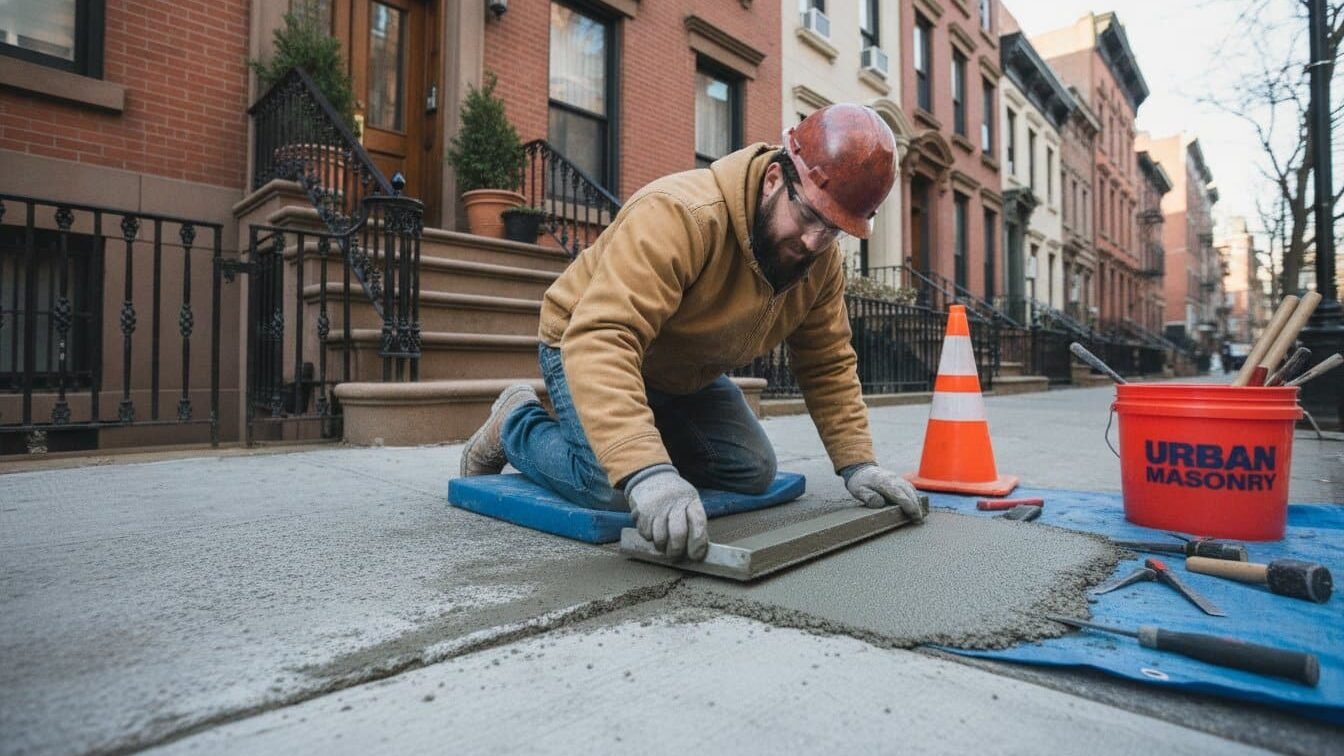
The third phase is the pour itself. We use high-strength concrete mixed to exact NYC specifications, applying a standard medium broom texture to ensure pedestrian safety and traction. Finally, phase four is the administrative dismissal. We don’t consider the job finished until we file the necessary paperwork to request a city inspection. This leads to the issuance of a Certificate of Correction, which is the only document that legally clears the violation from your property’s title. Neglecting this final step means the violation remains on record, even if the physical work is perfect.
Navigating the Permit Process
You cannot legally touch the sidewalk without a “Permit to Repair Sidewalk” from the DOT. Securing this permit requires a licensed and bonded contractor who understands city liability. If your sidewalk is being lifted by a city-owned tree, we must coordinate with the Parks Department. They often require specific root pruning techniques to protect the tree’s health while allowing for a level walkway. Handling these inter-agency requirements correctly is the only way to avoid additional fines and ensure your repair is recognized as compliant.
Passing the Final DOT Inspection
Once the concrete has cured, we request a dismissal inspection. The city inspector verifies that the pitch is correct for drainage and ADA accessibility. They also check that expansion joints are placed correctly and that the finish matches surrounding flags. After the inspection is passed, it can take several weeks for the violation to be officially removed from the public record. If you need to clear your title quickly for a sale, schedule an NYC sidewalk consultation today to get the process moving immediately.
Ensuring Long-Term Compliance with Brick Tech Contracting Corp
Since 1980, Brick Tech Contracting Corp has served as a steady guide for property owners facing the complexities of city mandates. We understand that the cost to remove sidewalk violation NYC represents a significant investment in your property’s safety and legal standing. Our approach prioritizes durability and structural integrity, ensuring that the work we perform today stands up to both the elements and future DOT inspections. By focusing on meticulous craftsmanship and high-strength materials, we help you avoid the cycle of repeated violations and patchwork repairs that often plague many New York buildings.
Successful compliance requires more than just a quick fix; it demands a comprehensive NYC sidewalk violation removal strategy. We don’t just address the symptoms of a broken sidewalk; we look for the underlying causes. Our team coordinates every aspect of the project, from initial permit acquisition to the final dismissal request, so you can focus on your daily operations without the stress of city-imposed deadlines. This seasoned perspective allows us to navigate the 75-day window with confidence and precision, providing peace of mind through reliable expertise.
Beyond the Sidewalk: Comprehensive Masonry Care
Get Your Free Sidewalk Repair Estimate Today
Timing is everything when you’re facing a 75-day deadline. We provide transparent, site-specific consultations that break down the cost to remove sidewalk violation NYC without hidden administrative surcharges. Our team moves quickly to file permits and schedule work, ensuring you beat the DOT clock and maintain a clear property title. When you partner with us, you get:
- Fast permit filing to ensure immediate compliance
- A site-specific plan that addresses DOT specifications exactly
- Direct coordination with city agencies for violation dismissal
- Durable, 2026-compliant concrete work built for longevity
Don’t wait for the city to take control of your repairs and send a non-negotiable bill. Contact our team today for a detailed estimate and a compliance plan tailored to your property’s unique needs. We are ready to help you secure a violation-free future with craftsmanship that stands the test of time.
Take Control of Your Property’s Compliance Path
Navigating a DOT notice doesn’t have to be a source of stress. By acting within the 75-day window, you maintain authority over the materials, the timeline, and the final cost to remove sidewalk violation NYC. Choosing a private path ensures that your property receives high-quality concrete work that meets every technical specification without the inflated administrative overhead of city-hired crews. A durable, compliant sidewalk is more than just a legal requirement; it’s a long-term investment in your building’s safety and market value.
As a licensed NYC contractor since 1980, Brick Tech Contracting Corp provides the steady expertise needed to clear your record efficiently. We offer a 100% DOT compliance guarantee across all five boroughs, handling everything from permit filing to the final inspection request. Our family-owned team views every project as a partnership, prioritizing structural integrity and clear communication. Don’t let a city-imposed lien complicate your property title. Request a Free Sidewalk Violation Removal Estimate from Brick Tech today to secure your investment. You can move forward with the confidence that your property is in expert hands.
Frequently Asked Questions
How long do I have to fix a sidewalk violation in NYC?
You have exactly 75 days from the date of the notice to complete the necessary repairs. This timeline is non-negotiable and serves as your window to hire a private contractor of your choice. If you fail to finish the work within this period, the city gains the legal right to perform the repairs using their own crews. Acting quickly helps you maintain control over the total project expenses and material quality.
Can I fix my own sidewalk to remove a DOT violation?
No, you cannot perform the repairs yourself unless you are a licensed and bonded contractor in New York City. The DOT requires a specific permit for any sidewalk work, and they only issue these to professionals with the proper insurance and credentials. Attempting a DIY fix won’t result in a violation dismissal and might lead to additional fines if the work doesn’t meet strict city specifications.
What happens if I don’t repair the sidewalk within 75 days?
If the 75-day deadline passes without a completed repair, the city will hire an outside contractor to do the work. You’ll receive a bill through the Department of Finance that often includes high administrative surcharges. This process removes your ability to negotiate the price or oversee the craftsmanship. If the bill remains unpaid, the city places a lien on your property title, which complicates future sales or refinancing.
How much does a DOT sidewalk permit cost in 2026?
In 2026, standard DOT sidewalk permits cost between $200 and $600 depending on the scope of the project. If you’re in a rush to clear a title for a property sale, expedited permits can range from $400 to $800. These fees are separate from the labor and material expenses. Your contractor typically handles the filing process to ensure the permit correctly matches the flags identified in your violation notice.
Does homeowners insurance cover the cost of sidewalk violation repairs?
Most homeowners insurance policies don’t cover the cost to remove sidewalk violation NYC. Standard policies view sidewalk maintenance as a routine property owner responsibility rather than a sudden, covered loss. While insurance might help if a specific accident occurs on your property, it rarely pays for the structural repairs required to clear a DOT notice. It’s always best to review your specific policy with your insurance agent for clarification.
How do I know if my sidewalk violation has been officially removed?
You can verify the status of your violation through the NYC DOT’s online portal or by checking your property’s title record. Once the work is inspected and approved, the city issues a Certificate of Correction. It can take several weeks for the public record to update. Your contractor should provide you with copies of the final inspection approval to keep for your personal records or for upcoming property transactions.
Why is my neighbor’s sidewalk repair bill different from mine?
Differences in repair bills usually stem from the specific technical requirements of each property. Your neighbor might have standard 4-inch flags, while your property requires 6-inch reinforced concrete for a driveway. Other factors that influence the cost to remove sidewalk violation NYC include the presence of city tree roots, the need for curb replacement, or different mobilization fees based on your specific borough’s parking and staging regulations.
Can the city repair my sidewalk without my permission?
Yes, the city can proceed with repairs without your explicit permission once the 75-day notice period has expired. The original violation notice serves as the legal authorization for the city to intervene if the owner fails to act. Because the city prioritizes public safety and ADA accessibility, they will move forward with their own contractors to eliminate hazards and then bill you for the full amount of the work.