Most property owners treat a crumbling entrance as a cosmetic issue, but a failing brownstone stoop is actually a structural warning sign that can’t be fixed with a bucket of standard hardware store cement. If you’re noticing spalling stone or “sugar” crumbling underfoot, you aren’t alone in your frustration. It’s stressful to watch your home’s historic character erode while worrying about the complexity of brownstone stoop repair NYC regulations. You want a restoration that honors original 19th-century craftsmanship without getting caught in Landmarks Preservation Commission (LPC) permit delays or hiring a contractor who uses cheap, incompatible materials.
This 2026 guide provides the clarity you need to protect your investment and restore your property’s curb appeal. We’ll show you how to identify deep structural decay, navigate the latest LPC requirements, and select the specialized cementitious compounds that ensure your stoop looks original and lasts for decades. From understanding 2026 permit timelines for minor work to choosing the right restoration method, you’re about to turn a trip hazard into your home’s greatest asset.
Key Takeaways
- Identify the difference between minor surface flaking and deep structural cracks to prevent costly long-term damage to your home’s entrance.
- Learn why the “solid core” restoration method, combined with professional-grade bonding agents, is the only way to ensure a repair lasts for decades.
- Avoid the common “paint trap” and other DIY mistakes by understanding why specialized mortar strength is essential for successful brownstone stoop repair NYC.
- Navigate the 2026 NYC Landmarks Preservation Commission (LPC) filing process and learn how to secure expedited permits for minor masonry work.
- Gain peace of mind by partnering with a family-owned expert that understands NYC’s specific environmental challenges and historic preservation standards.
Identifying Common Signs of Brownstone Stoop Deterioration
Your stoop serves as the literal gateway to your home, but in the five boroughs, it’s also a frontline defense against the elements. To understand why your entrance is failing, you first need to understand What is Brownstone and how its porous nature reacts to the local environment. This sedimentary rock is beloved for its warm aesthetic, yet it’s notoriously susceptible to New York’s harsh climate. Identifying early signs of decay is the first step in a successful brownstone stoop repair NYC project.
Spalling is one of the most visible indicators of trouble. This occurs when the outer layer of the stone begins to flake or peel away in thin, brittle sheets. It often starts small, but it’s a clear signal that the stone’s internal structure is weakening. You should also look for deep structural cracks. While hairline surface fissures might only require minor aesthetic patching, deep cracks that run through the masonry indicate a more significant structural failure that requires professional attention.
You can often detect “delamination” before the stone actually falls off. Use a small tool to gently tap the surface of the steps; a hollow, drum-like sound indicates the stone has separated from its solid masonry core. This separation is frequently accelerated by NYC’s freeze-thaw cycles and the heavy use of de-icing salts. These elements work together to degrade the stone’s integrity, turning a once-solid entrance into a crumbling liability.
The Dangers of Water Infiltration
Water is the primary enemy of historic masonry. During New York winters, moisture penetrates the stone’s pores and expands as it freezes, creating immense internal pressure. You might notice white, powdery salt deposits known as “efflorescence” on the stone’s surface. These deposits are a red flag that moisture is moving through the masonry and leaching out minerals. Unchecked water infiltration causes internal steel rebar to corrode and expand, which eventually shatters the surrounding masonry from within.
Safety Hazards and Liability for NYC Owners
Deterioration isn’t just an eyesore; it’s a safety risk. Uneven treads and loose railings are primary trip hazards that create significant liability for property owners. Because these stoops often sit directly adjacent to public walkways, they are subject to NYC Department of Buildings (DOB) oversight. A crumbling stoop can lead to sidewalk-adjacent violations that are expensive and time-consuming to resolve. Taking action early prevents a total stoop collapse and protects both your neighbors and your financial investment.
The Art and Science of Brownstone Stoop Restoration
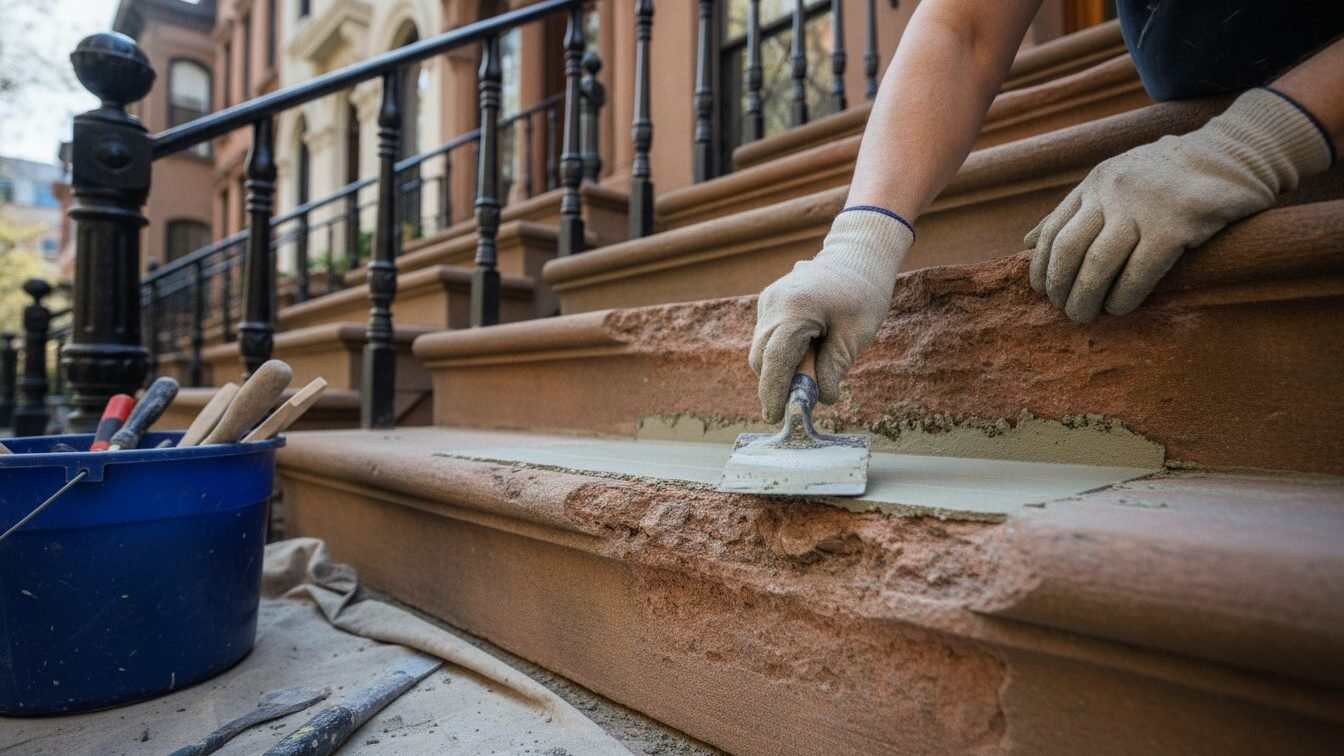
Authentic restoration begins with a surgical approach to removal. We don’t just cover up cracks; we identify the “dead” stone that has lost its structural integrity and remove it entirely until we reach the solid masonry core. This step is critical. If any deteriorated stone remains, the new repair will eventually separate and fail. Once the core is exposed and cleaned, we apply a specialized bonding agent to create a permanent chemical and mechanical lock between the old masonry and the new restoration layers.
The repair then proceeds through a precise three-stage layering process that most general contractors skip. First, the scratch coat is applied to provide a high-grip surface for the subsequent layers. Second, the brown coat builds out the volume and establishes the stoop’s geometry. Finally, the finish coat is meticulously applied. This is where custom color matching occurs. We blend specific pigments to ensure the repair is indistinguishable from the original facade, maintaining the seamless look of your historic home.
The Specialized Brownstone Compound
Many property owners are surprised to learn that standard Portland cement is the enemy of historic stone. It’s too rigid for soft NYC brownstone. Because the original stone is naturally porous, it needs to “breathe” to release moisture. Portland cement traps that moisture, which causes the surrounding original stone to crack and shatter during winter. We use breathable, lime-based mortars that mirror the stone’s natural expansion and contraction. Expert tooling is then used to recreate the specific “sandstone” texture found in 19th-century architecture, ensuring a historically accurate finish.
Restoring Railings and Decorative Elements
A successful brownstone stoop repair NYC project must also address the ironwork. Heavy daily foot traffic requires railings to be rock-solid. We reset iron posts into the stone using lead or high-performance modern anchors. This prevents water from seeping into the core, which is a primary cause of internal stone rot. If your stoop features intricate scrollwork or specific historic profiles, these are meticulously recreated by hand to maintain the property’s architectural value. For a detailed assessment of your home’s unique masonry needs, consider a professional facade restoration consultation to protect your investment for the long term.
Choosing Your Team: Specialist vs. General Handyman
Choosing the right contractor for brownstone stoop repair NYC is the difference between a lifelong investment and a recurring expense. While a general handyman might offer a lower quote, their methods often lead to the “Paint Trap.” Handymen frequently suggest painting a crumbling stoop to hide imperfections quickly. This is a catastrophic mistake. Paint creates a non-breathable seal that traps moisture inside the stone, which accelerates internal rot and leads to massive stone failure within two seasons. A specialist understands that brownstone stoop repair NYC requires materials that breathe to survive the local climate.
General contractors also tend to use standard Portland-based mortars designed for hard modern bricks. These mixes are far too rigid for historic stone. When the temperature shifts, the hard mortar doesn’t move, which forces the softer brownstone to crack around the repair. You should evaluate a masonry portfolio for specific historic facade restoration projects rather than simple brickwork. Ensure any team you hire is fully licensed and insured for NYC residential work to protect yourself from liability and ensure the project meets building codes.
Long-Term ROI of Professional Restoration
A professional restoration is designed to last 30 years or more, while a cheap patch job typically fails in under 24 months. In high-value neighborhoods across Brooklyn and Manhattan, the condition of your stoop directly impacts property appraisals. Appraisers look for architectural integrity; a poorly patched or painted stoop signals deferred maintenance and can lower your home’s valuation. By investing in the right methods now, you avoid the heavy cost of doing it twice when a sub-standard repair inevitably falls apart.
Questions to Ask Your NYC Masonry Contractor
Before signing a contract, vet your team with these specific questions:
- What type of bonding agent and compound mix do you use? Ensure they mention lime-based, breathable materials rather than standard cement.
- How do you handle color matching for historic districts? They should explain their process for blending pigments to match your specific facade.
- Can you assist with LPC permit applications? A reliable expert should be familiar with the Landmarks Preservation Commission’s requirements for your neighborhood.

Navigating NYC Landmarks and Stoop Repair Costs
Owning a historic home in Brooklyn or Manhattan is a point of pride, but it also means adhering to the strict standards of the NYC Landmarks Preservation Commission (LPC). Before you begin any brownstone stoop repair NYC, you need to confirm if your property is located within a designated historic district. This status dictates the types of permits you’ll need and the materials you’re allowed to use. While the LPC focuses on preserving the visual history of the neighborhood, the Department of Buildings (DOB) ensures that any masonry work adjacent to the sidewalk meets current safety codes.
For many homeowners, the “Expedited Review” process is a welcome relief. This fast-track option is typically available for minor masonry repairs and stoop refinishing that don’t change the home’s original appearance. It allows you to move forward with essential maintenance without the lengthy wait times often associated with major architectural changes. Navigating these two agencies requires a clear understanding of where aesthetic preservation ends and structural compliance begins.
The LPC Permit Process for Stoops
The type of permit you need depends on the scope of your project. A Permit for Minor Work (PMW) is usually sufficient for in-kind repairs where you’re restoring the stoop to its original state. However, if you’re making alterations, you’ll likely need a Certificate of Appropriateness, which involves a more rigorous review and potentially a public hearing. As of 2026, the LPC requires detailed documentation to approve your project. This includes providing physical stone samples and color swatches that match the original facade. For a deeper look at how we maintain these standards, explore our resource on Historic Brownstone Facade Restoration NYC Techniques.
Budgeting for Your 2026 Restoration
Calculating the cost of your project involves more than just counting the number of steps. While “per step” pricing is a common industry baseline, the final investment depends heavily on the condition of the masonry core and the complexity of the decorative details. Restoring original iron railings is often more cost-effective and historically appropriate than replacement, but it requires specialized labor to reset the posts correctly. You can learn more about how material and labor variables influence project totals by reading about Brick Pointing Rates: Cost Factors for NYC Masonry. To get a precise estimate tailored to your home’s unique needs, contact our team for a professional site assessment today.
Professional Brownstone Stoop Repair with Brick Tech Contracting Corp
Brick Tech Contracting Corp has spent over 40 years restoring the character of New York City neighborhoods. We don’t view our work as a series of quick fixes. Instead, we take a relationship-first approach to historic property maintenance. We understand that your home is your most significant investment. Our goal is to ensure that every project, from a minor masonry patch to a complex brownstone stoop repair NYC, stands the test of time and protects your family’s safety.
Our expertise extends across the entire exterior of your property. While the stoop is often the focal point of a facade, we provide comprehensive care that includes everything from structural maintenance to parapet wall construction. By looking at the building as a whole, we identify how different structural elements interact and affect one another. This holistic view prevents moisture issues from migrating from the roofline down to your newly restored steps. We’re dedicated to ensuring your home remains a safe, beautiful investment for the next generation.
Family-Owned Expertise Since 1980
Being family-owned and operated since 1980 gives us a unique perspective on the NYC construction industry. We have deep roots in the local boroughs and a clear understanding of the environmental challenges your masonry faces. We’ve watched how decades of freeze-thaw cycles affect historic stone. This knowledge drives our commitment to using authentic, breathable materials that respect the original 19th-century architecture while meeting modern durability standards.
We prioritize direct communication with property owners throughout the entire restoration process. You’ll never be left wondering about the status of your project or the specific compounds being used on your facade. We believe that transparency is the foundation of trust. By combining traditional craftsmanship with modern technical precision, we deliver results that honor the history of your home and provide lasting stability.
Get a Professional Assessment Today
The first step in protecting your home is a thorough evaluation of its current condition. We invite you to schedule a site visit to evaluate the structural integrity of your entrance. Our experts will look for signs of delamination and water infiltration discussed earlier in this guide to provide a clear path forward. We provide transparent estimates that focus on long-term solutions rather than superficial patches.
You won’t find hidden “NYC fees” or vague line items in our proposals. We believe in providing clear, actionable information so you can make the best decision for your property. Whether you’re dealing with a DOB violation or simply want to restore your home’s curb appeal, we’re here to guide you. Contact Brick Tech Contracting Corp for a free stoop repair estimate and ensure your brownstone stoop repair NYC is handled by seasoned experts who care about the details.
Protecting Your Historic NYC Investment for the Long Term
A historic stoop is more than just an entrance; it’s a vital piece of New York City’s architectural history. We’ve covered how to identify the early warning signs of spalling, the critical need for breathable lime-based compounds, and the complexities of the 2026 LPC permitting landscape. Choosing the right restoration method ensures that your brownstone stoop repair NYC project results in a safe, beautiful structure that withstands the city’s harsh freeze-thaw cycles while adding significant value to your property.
Brick Tech Contracting Corp offers the specialized expertise required to handle these unique masonry challenges. As family-owned NYC experts since 1980, we take pride in our 4.9-star average for masonry restoration and our deep understanding of LPC and DOB compliance. We treat every property as a partnership, prioritizing long-term durability and structural integrity over quick fixes. You don’t have to navigate the restoration process alone. Request a Free Brownstone Stoop Inspection today to get a professional assessment of your home’s needs. Your entrance is the face of your home, and with the right care, it’ll remain a source of pride for generations to come.
Frequently Asked Questions
How much does brownstone stoop repair cost in NYC?
Costs for brownstone stoop repair NYC vary based on the level of deterioration and the complexity of decorative details. In 2026, industry ranges for standard restoration typically fall between $3,000 and $15,000. These figures depend on factors like the number of steps and the condition of the masonry core. Structural issues or intricate ironwork repairs can increase the final investment. We provide transparent site assessments so you don’t have to guess your project’s cost.
Do I need a permit from the Landmarks Preservation Commission to fix my stoop?
You generally need a permit if your property is located within a designated historic district. For in-kind repairs that match the original materials and appearance, you can often apply for a Permit for Minor Work (PMW). This expedited review process is faster than applying for a Certificate of Appropriateness. Failing to secure the proper landmarks approval can result in significant fines and legal violations. Our team assists with the documentation required for these applications.
How long does a typical brownstone stoop restoration take?
A standard restoration project usually takes between one and two weeks to complete, depending on the weather and the extent of the damage. This timeline includes the time needed for removing deteriorated stone, applying multiple layers of specialized compound, and allowing for proper curing between coats. Intricate decorative work or ironwork resetting might extend the duration. We coordinate the schedule to minimize disruption to your daily routine while ensuring a high-quality, durable finish.
Can you fix a brownstone stoop in the winter?
Masonry repairs are best performed when temperatures remain consistently above 40 degrees Fahrenheit. While some emergency work can be done with specialized heating enclosures, cold weather generally interferes with the curing process of breathable, lime-based mortars. Freezing temperatures cause the moisture in the wet compound to expand, which leads to immediate cracking. We typically schedule major brownstone stoop repair NYC projects during the spring or summer so you don’t have to worry about premature failure.
Why is my brownstone stoop crumbling or “spalling”?
Spalling is primarily caused by water infiltration and the freeze-thaw cycles common in New York City. Brownstone is a porous sedimentary rock that absorbs moisture easily. When that water freezes, it expands and creates internal pressure that forces the outer layers of the stone to flake or peel away. This process is often accelerated by the use of harsh de-icing salts. Identifying these signs early prevents the damage from reaching the solid masonry core of your entrance.
Is it better to repair or completely rebuild a brownstone stoop?
Most stoops can be successfully restored through professional masonry techniques if the structural core remains sound. Repairing is generally more cost-effective and preserves more of the original historic material. However, if the internal masonry has completely collapsed or the foundation is shifting, a full rebuild may be necessary to ensure safety. We perform a detailed structural assessment to determine which path provides the best long-term return on your investment and matches your home’s facade.
What is the best way to clean a brownstone stoop after repair?
Use a gentle, low-pressure water rinse and a soft-bristled brush to clean your stoop after the restoration has fully cured. Avoid high-pressure power washing; it’s too aggressive for new stone and can open pores to future water damage. Harsh chemical cleaners or acid-based solutions should also be avoided because they react poorly with the lime-based mortar. Regular, gentle maintenance is the most effective way to protect the stone’s integrity and keep it looking new.
Does a brownstone repair need to match the original building color?
Matching the original color is a strict requirement for properties within NYC landmarks districts to maintain architectural consistency. We use custom-blended pigments in the final finish coat to ensure the repair is indistinguishable from the rest of the facade. Even for non-landmarked buildings, color matching is essential for curb appeal and property value. A mismatched repair looks like a temporary patch and can signal deferred maintenance to future buyers or appraisers during a home inspection.