A single patch of rust on your fire escape isn’t just an eyesore; it’s a $5,000 liability waiting to be flagged by the Department of Buildings. For many NYC property owners, the sight of peeling paint or corroded metal brings a sense of dread about potential FDNY fines and the structural integrity of their emergency exits. It’s a valid concern because your fire escape is a lifeline that demands more than a quick coat of hardware store paint. We understand that keeping up with shifting regulations feels like a full-time job, especially with the strict requirements of FISP Cycle 10 now in effect.
This guide provides a clear path through the complexities of fire escape painting NYC, ensuring your building stays compliant and your residents remain safe. You’ll learn exactly what the DOB expects regarding fire-retardant coatings, lead-safe preparation, and the critical masonry-metal interface where most structural failures begin. We’ve spent over 40 years watching how the local climate treats iron and brick, and we’re here to help you avoid costly violations while protecting your long-term investment. From understanding staggered filing windows to mastering rust-inhibitive primer techniques, this is your complete resource for restoration and compliance in 2026.
Key Takeaways
- Identify your building’s specific FISP Cycle 10 filing deadlines to avoid costly DOB penalties and ensure timely compliance.
- Understand the technical requirements for fire escape painting NYC, including the necessity of fire-retardant coatings and proper lead-safe surface preparation.
- Learn why the interface between metal anchors and masonry is a high-risk area and how to prevent “oxide jacking” from damaging your building’s facade.
- Discover the difference between a cosmetic refresh and a structural restoration that meets the rigorous safety standards of the FDNY and DOB.
- Gain insights into how a holistic maintenance approach can extend the lifespan of your fire escape while protecting the structural integrity of your entire property.
Why Fire Escape Painting NYC Standards Matter for Property Owners
In the high-density boroughs of New York City, a fire escape is more than just a metal attachment; it’s a critical life-safety component. The History of fire escapes shows they were designed as a last line of defense during emergencies, a role that remains unchanged today. When these structures are neglected, they transition from safety assets to significant liabilities. Maintaining them isn’t an optional cosmetic choice, but a legal mandate enforced by both the Department of Buildings (DOB) and the FDNY.
As a family-owned firm established in 1980, we’ve seen how our city presents a unique set of challenges for metal structures. Salt air blowing in from the Atlantic, combined with acid rain and relentless freeze-thaw cycles, creates a corrosive environment that eats through standard coatings. Corrosion is a constant threat. Over our 40 years of service, we’ve seen how quickly surface rust turns into structural pitting. If you don’t invest in professional fire escape painting NYC, you’re essentially allowing the elements to slowly dismantle your building’s emergency exits. By the time the rust is visible from the street, the internal integrity of the iron may already be compromised.
DOB and FDNY Compliance Standards
Section 15-10 of the NYC Fire Code is explicit about the upkeep of exterior stairs and fire escapes. The city requires these structures to be kept free of rust and protected by at least two coats of fire-retardant paint. Under the current FISP Cycle 10 regulations, buildings over six stories must undergo a professional inspection every five years. Failing to file a report can result in an annual penalty of $5,000, while late filings incur monthly fines of $1,000. Maintaining compliance through professional fire escape painting NYC is the only way to avoid these escalating costs. A ‘System Violation’ notice is far more than a slap on the wrist; it’s a signal that your building is legally unsafe for occupancy.
The Impact of Neglect on Property Value
A rusted, peeling fire escape sends a clear message of mismanagement to both current and prospective tenants. Beyond the immediate loss of curb appeal, neglect leads to ‘pitting,’ where the metal actually loses mass and strength. This structural decay is often irreversible without expensive replacement parts. Along with these physical risks, insurance companies are increasingly scrutinizing life-safety structures during renewals. If your fire escape shows signs of advanced corrosion, you may face higher premiums or even policy cancellations. Regular maintenance through professional painting protects your residents, your reputation, and your bottom line.
The Professional Fire Escape Restoration Process
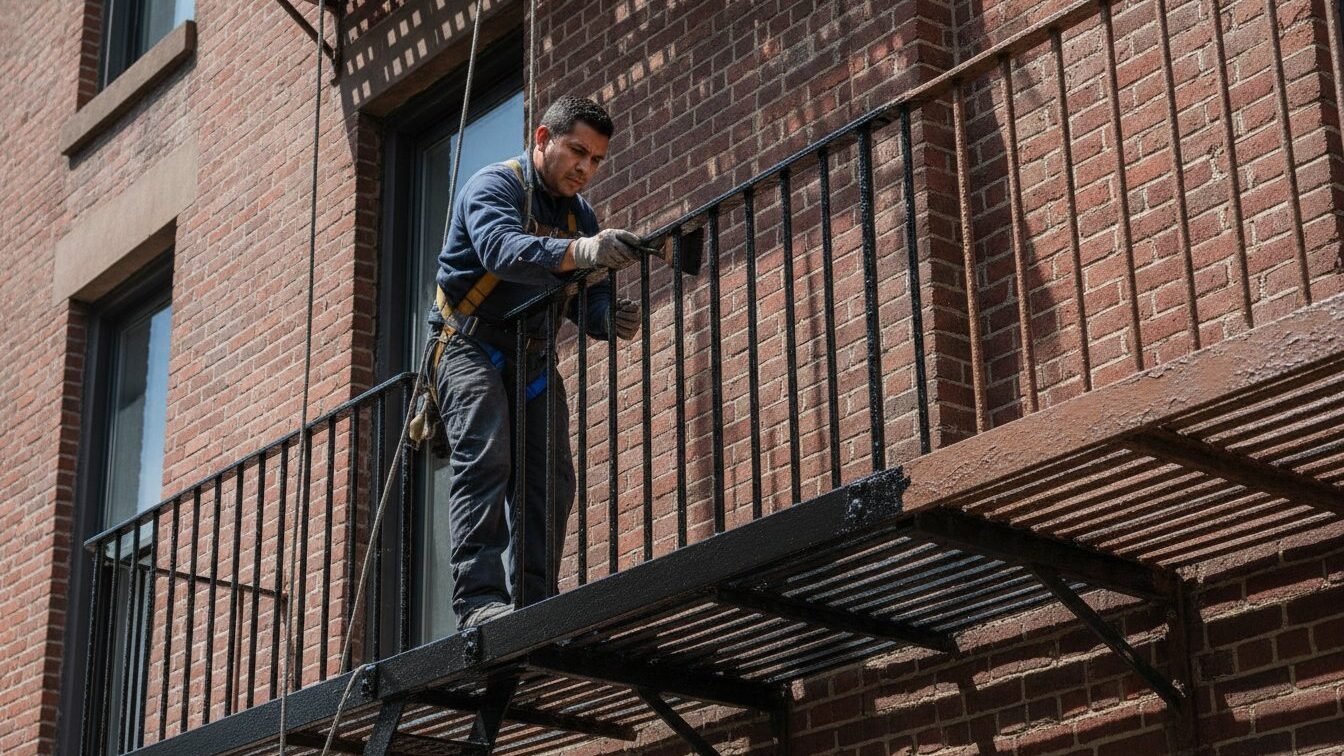
Restoring an emergency exit requires a methodical engineering approach rather than a purely cosmetic one. In a city where moisture and salt air are constant threats, our process for fire escape painting NYC focuses on creating a multi-layered defense system. We begin with comprehensive site protection, using heavy-duty drop cloths and plastic sheeting to contain all debris and prevent paint splatter on your building’s facade or the sidewalk below. This containment is essential for maintaining a clean worksite and protecting pedestrians in high-traffic areas.
Mechanical surface preparation follows, where we utilize scraping and wire brushing to meet SSPC (Society for Protective Coatings) standards. We don’t just remove loose flakes; we strip the metal down to a sound substrate to ensure the new coating bonds permanently. After cleaning, we apply rust inhibitors or converters to neutralize any remaining microscopic oxidation. This chemical stabilization is followed by a high-solids industrial primer and a weather-resistant topcoat. These steps are vital for maintaining the structural adequacy and safety of the unit, ensuring it remains a reliable exit for decades.
Surface Preparation: The Most Critical Step
Painting over existing rust is a band-aid that leads to failure within months. Rust is porous; it traps moisture and oxygen against the metal, allowing corrosion to continue unseen beneath a fresh coat of paint. For older NYC buildings, we also prioritize lead-safe practices. If lead-based paint is present, we follow strict containment and disposal protocols to protect your tenants and the environment. Using power tool cleaning provides a “tooth” or texture to the metal, which is necessary for the industrial-grade primers to achieve maximum adhesion. If you are concerned about the current state of your building’s exterior, a professional facade restoration specialist can help identify the best path forward.
Material Science: Primers and Coatings
The chemistry of the coatings we select is designed for the harsh Queens and Brooklyn climates. We often utilize zinc-rich primers that provide cathodic protection. This means the zinc sacrifices itself to protect the underlying iron or steel from corroding. When it comes to topcoats, urethanes generally offer superior UV resistance and flexibility compared to traditional enamels, which can become brittle over time. While black remains the traditional color for NYC fire escapes, we can apply various industrial shades to complement your building’s architectural style. The goal is always a finish that resists the “pitting” caused by acid rain and urban pollutants.
The Intersection of Masonry and Metal: A Structural Deep Dive
The most vulnerable part of any fire escape isn’t the stairs or the railings; it’s the anchor point where the metal meets the masonry. While many property owners focus on the visible surface, the real danger often hides inside the wall. When water penetrates the entry point of a support beam, it triggers internal corrosion that can compromise the entire structure. Professional brick pointing NYC is essential to seal these gaps and prevent moisture from reaching the embedded steel. Without a watertight seal at these junctions, the most expensive paint job in the world won’t prevent structural failure.
One of the clearest warning signs of anchor decay is “weeping” rust. These are the telltale orange streaks that run down your facade from the support brackets. These stains indicate that the internal metal is oxidizing and losing its structural mass. If left unaddressed, this process leads to a phenomenon known as oxide jacking. Because rust occupies significantly more volume than the original steel, it exerts immense outward pressure on the surrounding masonry. This expansion can literally crack your building’s bricks and force them out of alignment. Effective fire escape painting NYC must be paired with an inspection of these critical connection points to ensure the metal is seated in sound, stable material.
Oxide Jacking and Facade Damage
The science of oxide jacking is a primary cause of facade failure in older New York buildings. As the metal support expands, it destroys the bond between the brick and the mortar. This creates a destructive cycle: the cracks allow more water to enter, which leads to more rust and further expansion. Coordinating your maintenance with a comprehensive facade restoration NYC program ensures that these penetrations are properly waterproofed. We focus on the holistic health of the building envelope, recognizing that a fire escape is only as safe as the wall holding it up.
Evaluating Anchor Integrity
A simple “shake test” is never enough to confirm structural safety. Professional evaluations require checking for movement, metal loss, and the condition of the receiving wall. In some cases, the top-rails of a fire escape are anchored directly into a parapet. If the wall is leaning or the mortar is crumbling, you may need parapet wall construction New York to provide a secure foundation for the safety structure. We ensure every anchor is seated in solid masonry rather than deteriorating joints. This integrated approach to fire escape painting NYC provides long-term stability and peace of mind for property managers.

FISP and Local Law 11: Fire Escapes in the Inspection Cycle
The Façade Inspection & Safety Program (FISP), formerly known as Local Law 11, dictates the maintenance rhythm for buildings taller than six stories across the five boroughs. Under this mandate, fire escapes are classified as appurtenances and must undergo a rigorous structural examination every five years. For many owners, the most common result of these inspections is a “Safe With a Repair and Maintenance Program” (SWARMP) status. This classification often stems from visible surface corrosion or peeling coatings. While not immediately dangerous, a SWARMP status requires you to complete professional fire escape painting NYC before the next filing cycle to avoid a $2,000 penalty for failure to correct conditions.
A Qualified Exterior Wall Inspector (QEWI) is responsible for certifying the safety of these structures. They look for more than just aesthetics; they evaluate the thickness of the metal and the security of every connection point. Maintaining detailed documentation of your maintenance history is vital. When your QEWI sees records of high-quality industrial coatings and professional repairs, it streamlines the certification process and demonstrates proactive management. In 2026, the DOB has increased its focus on the linear footage of safety structures, making it more important than ever to have your paperwork and your metalwork in top condition.
Preparing for Your 5-Year Inspection
Preparation is the best way to avoid an “Unsafe” classification, which triggers immediate repair requirements and monthly fines of $1,000. Before your QEWI arrives, conduct a walkthrough to identify red flags. Check for missing bolts, loose slats, or drop ladders that have been painted shut. If you notice moisture pooling where the metal meets the wall, engaging a waterproofing contractor NYC can help seal those penetrations before they lead to structural failures. Addressing these minor issues early prevents them from becoming the primary reason your building fails its FISP filing.
Resolving NYC Sidewalk and Building Violations
Navigating building violations often feels like a maze, but the process for fire escape compliance is similar to NYC sidewalk violation removal. Once the professional fire escape painting NYC is finished, you must file a Certification of Correction with the DOB. This paperwork confirms that the work was performed to code and that the safety hazards have been mitigated. Hiring a licensed contractor is non-negotiable for these sign-offs. The city requires professional accountability to ensure that life-safety systems are restored correctly, not just covered with a cosmetic layer of paint. If you are currently facing a deadline for Sub-cycle 10B, you should consult with a compliance expert to ensure your filing is accurate and timely.
Brick Tech: NYC’s Reliable Expert for Fire Escape and Facade Care
Brick Tech Contracting Corp isn’t just another painting crew; we’re a family-owned masonry and restoration firm that’s been rooted in New York City since 1980. For over 40 years, we’ve navigated the evolving landscape of building codes and the harsh realities of the local climate. We understand that a fire escape is a structural lifeline, not just a decorative ornament. Our specialized approach bridges the gap between industrial metalwork and expert masonry, ensuring that your life-safety systems are as solid as the walls they’re attached to.
Choosing a partner for fire escape painting NYC requires a contractor who understands the entire building envelope. We’ve spent decades observing how salt air, acid rain, and urban pollutants interact with NYC’s historic architecture. This veteran perspective allows us to anticipate problems before they lead to DOB violations or structural failure. We don’t just apply a coat of paint; we perform a comprehensive evaluation of the masonry-metal interface to ensure long-term durability and peace of mind for every property owner we serve.
The Brick Tech Advantage
Our legacy is built on a foundation of transparency and reliability. When we handle your fire escape painting NYC project, we treat it with the meticulous care it deserves. Our process includes:
- Thorough site protection to prevent damage to your facade or sidewalk.
- Strategic surface preparation that meets rigorous industrial standards.
- Integration of masonry repairs, such as brick pointing, to secure anchor points.
- Meticulous cleanup that respects your tenants and the surrounding neighborhood.
We take pride in our neighborhood-friendly work practices. We understand that construction in high-density boroughs like Brooklyn or Queens can be disruptive, so we focus on efficient, clean, and professional execution. Our goal is always to provide a result that enhances your building’s safety and curb appeal without unnecessary stress.
Schedule Your Exterior Consultation
Protecting your investment starts with a holistic view of building maintenance. We integrate fire escape care with our broader suite of services, from facade restoration to sidewalk repair. This comprehensive strategy ensures that no part of your building’s exterior is left vulnerable to decay or legal scrutiny. Our team is committed to keeping your property violation-free and compliant with the latest FISP Cycle 10 requirements. If you’re ready to partner with a trusted restoration team, contact Brick Tech today to discuss your building’s specific needs and ensure its long-term protection.
Secure Your Building’s Future and Compliance
Maintaining a fire escape is a critical responsibility that goes beyond simple aesthetics. As FISP Cycle 10 deadlines approach, ensuring your structure meets the specific standards for fire escape painting NYC is the only way to protect your residents and your bottom line. We’ve seen how oxide jacking and urban corrosion can compromise even the strongest ironwork, making proactive restoration a structural necessity rather than a cosmetic luxury.
Brick Tech Contracting Corp has been serving NYC property owners since 1980. As licensed and insured exterior specialists, we bring over 40 years of expertise in DOB and FDNY violation removal to every project. We understand the technical requirements of the masonry-metal interface and provide the durable results your property deserves. Our team views every restoration as a partnership, prioritizing long-term safety and the integrity of your investment.
Get a Professional Fire Escape Inspection and Estimate to stay ahead of the city’s inspection cycle. Taking action today ensures your building remains safe, compliant, and well-managed for years to come.
Frequently Asked Questions
How often does a fire escape need to be painted in NYC?
New York City code requires fire escapes to be kept rust-free and protected by at least two coats of paint at all times. While the law doesn’t mandate a specific yearly interval, the five-year FISP inspection cycle serves as the primary benchmark. Most properties require a full repainting every five to seven years, though buildings in coastal areas like the Rockaways or Coney Island may need more frequent maintenance due to salt air corrosion.
What is the typical cost for fire escape painting in Manhattan or Brooklyn?
The total investment for a restoration project depends on the size of the structure, the height of the building, and the current level of corrosion. Factors such as the need for lead paint containment and the complexity of site access also play a role. Because every building presents unique structural challenges, we recommend a professional consultation to evaluate your specific needs rather than relying on generic industry averages that may not reflect your property’s requirements.
Does the DOB require a permit for fire escape painting?
Routine maintenance and fire escape painting NYC typically do not require a Department of Buildings permit. However, if the project involves structural work, such as welding, replacing support brackets, or installing new treads, a permit is mandatory. It’s vital to work with a contractor who can distinguish between cosmetic upkeep and structural alterations to ensure your building remains compliant with all local safety regulations.
Can I paint my own fire escape to remove a violation?
No, property owners shouldn’t attempt to DIY fire escape repairs to resolve a violation. The DOB and FDNY require that life-safety systems be maintained by licensed professionals who can certify the work meets specific code standards, including the use of fire-retardant coatings. A professional contractor also ensures lead-safe practices and proper surface preparation, which are necessary for the city to officially sign off on a Certificate of Correction.
What is the best time of year for fire escape painting in New York?
The ideal window for fire escape painting NYC is during the spring and fall when temperatures are moderate and humidity is low. Most industrial-grade coatings require the temperature to stay above 50 degrees Fahrenheit for at least 48 hours to cure correctly. We generally advise against painting in mid-winter or during periods of extreme summer heat, as these conditions can cause the paint to bubble or fail to bond with the metal substrate.
How do I know if my fire escape is structurally sound or just needs paint?
Visible “pitting” in the steel, loose or missing slats, and orange rust streaks “weeping” from masonry anchors are clear signs of structural decay. While surface rust is often a cosmetic issue, metal loss or movement in the platforms indicates that the integrity of the structure is compromised. A professional inspection is the only reliable way to determine if your emergency exit requires a simple recoating or a more intensive structural restoration.
What is the difference between scraping and professional surface preparation?
Basic scraping only removes loose flakes, but professional preparation involves mechanical wire brushing to SSPC standards to reach a sound substrate. This process creates a “tooth” in the metal, which is necessary for high-solids industrial primers to achieve a permanent bond. Professional restoration also includes applying chemical rust inhibitors to neutralize microscopic oxidation, preventing corrosion from returning and pushing the new paint off from the inside out.
Will painting my fire escape help with Local Law 11 compliance?
Yes, keeping your fire escape well-maintained is a critical part of the Façade Inspection & Safety Program (FISP). An inspector will often classify a rusted or peeling fire escape as “Safe With a Repair and Maintenance Program” (SWARMP), which forces you to perform repairs before the next filing cycle. Proactive painting prevents these structures from being downgraded to “Unsafe,” helping you avoid the $1,000 monthly penalties associated with uncorrected safety conditions.