Did you know that NYC 311 recorded 25,809 sidewalk condition complaints in 2025 alone? For a property owner, that’s not just a number; it’s a reminder that the city is actively monitoring your walkways for safety and compliance. It’s natural to feel anxious when you’re faced with a Notice of Violation, especially if you’re unsure how to navigate the technical NYC sidewalk repair specifications required to clear it.
You shouldn’t have to worry about paying for a repair that fails a DOT inspection because of a minor technicality. This guide provides the clarity you need to master the technical requirements, from the 4000 PSI concrete strength to the exact 1 inch in 5 foot slope. We’ll walk you through a clear checklist of specs to give your contractor, ensuring your masonry work is built for structural integrity and long term protection against NYC winters. You’ll learn exactly what’s needed to remove a violation and secure your property’s value for years to come.
Key Takeaways
- Understand your legal obligations under NYC Administrative Code Section 19-152 to ensure your property remains safe and compliant with city standards.
- Learn the exact NYC sidewalk repair specifications, including the 4500 PSI concrete requirement and standard flag geometry, to pass DOT inspections.
- Master critical slope and drainage standards to prevent standing water and ensure your masonry work withstands NYC’s harsh winter freeze-thaw cycles.
- Identify if your property falls within a historic district, which may require specialized materials like bluestone or pigmented concrete to maintain aesthetic compliance.
- Navigate the violation removal process efficiently by securing proper DOT permits and completing repairs within the mandatory 75-day window.
Understanding NYC DOT Sidewalk Rules and Compliance
Ownership in New York City comes with specific responsibilities that extend beyond your building’s front door. According to NYC Administrative Code Section 19-152, property owners are legally required to maintain the sidewalk adjacent to their property in a reasonably safe condition. A “legal” sidewalk is strictly defined by the NYC DOT Standard Highway Specifications. These rules dictate everything from the depth of the concrete to the layout of the flags. If your walkway doesn’t meet these NYC sidewalk repair specifications, the Department of Transportation has the authority to issue a Notice of Violation, which can complicate property sales or lead to significant fines.
One common mistake owners make is attempting to “patch” or “skim” a damaged flag with a thin layer of cement. While it might look better temporarily, city inspectors strictly prohibit these superficial fixes. Patching doesn’t address the underlying structural issues, and it often fails during the first winter freeze-thaw cycle. The DOT requires a full-depth replacement of the affected flag to ensure the repair is durable. This methodical approach ensures that the sidewalk remains a stable part of the city’s infrastructure for years to come.
The Property Owner’s Legal Duty
The “sidewalk law” isn’t just about aesthetics; it’s about public safety and liability protection. If a pedestrian is injured on a non-compliant sidewalk flag, the property owner is often held legally responsible for damages. Beyond legal fees, there’s the risk of a “City-Led” repair. If you don’t address a violation within the 75-day window, the city may hire its own contractor to do the work. This usually results in a much higher bill than hiring a private specialist, plus a 7% administrative fee. You lose control over the timeline and the final cost, making proactive maintenance the smarter financial choice.
Identifying DOT-Defined Sidewalk Defects
To stay ahead of inspectors, you need to know what they’re looking for during an assessment. The most common trigger for a violation is the “1/2-inch rule.” Any vertical displacement or trip hazard of a half-inch or more between sidewalk flags is considered a defect. You should also watch for specific patterns of wear:
- Hardware Defects: Trip hazards caused by sunken or raised gratings, vault covers, or utility plates that aren’t flush with the concrete.
- Crumbling and Spalling: Surfaces that are peeling or “alligator” cracking patterns that indicate the concrete has lost its structural integrity.
- Improper Materials: Using the wrong Sidewalk construction materials can lead to premature failure and immediate violation.
Understanding these NYC sidewalk repair specifications helps you identify problems before they become costly legal headaches. By focusing on high-quality craftsmanship and technical precision, you protect both your investment and the pedestrians who use your walkway every day.
Material and Structural Specifications for NYC Sidewalks
Building a sidewalk that survives a New York winter starts with the right mix. While older standards might have been lower, the current NYC sidewalk repair specifications for 2026 demand a 4500 PSI concrete mix. This high-strength concrete is designed to withstand the heavy foot traffic and chemical salts common in the five boroughs. This higher PSI rating provides a denser finish that resists water penetration better than standard residential mixes. If your contractor uses a weaker mix, you risk premature cracking and another visit from a DOT inspector.
Beyond the concrete itself, the geometry of the installation matters. The city standard follows a 5-foot by 5-foot grid pattern, creating the familiar “flags” seen across the city. This isn’t just for looks. This specific grid size helps distribute weight and allows for controlled movement as the ground shifts. When these flags are sized correctly, they are much less likely to buckle or heave during extreme temperature changes.
Concrete and Reinforcement Standards
Durability in our climate depends on air-entrained concrete. This specialized mix contains microscopic air bubbles that give moisture room to expand when it freezes. Without it, the surface will likely spall or flake within just a few years. For standard pedestrian walkways, a thickness of 4 inches is required. However, if the sidewalk crosses a driveway, the spec jumps to 7 inches of reinforced concrete to handle the weight of vehicles. Most of the city uses unpigmented concrete, though some historic areas have different rules we will cover later.
Joints and Scoring Patterns
Expansion joints are the “breathing room” for your sidewalk. These must be placed at 20-foot intervals and wherever the concrete meets a building line or a curb. We use full-depth expansion material, typically a pre-molded bituminous filler, to ensure the flags can expand without buckling. This material should be slightly recessed and sealed to prevent water from reaching the subgrade. Between these expansion joints, we use dummy joints or scoring. These are deep grooves cut into the wet concrete to encourage any potential cracking to happen in a straight, hidden line rather than across the middle of a flag.
Foundation Preparation
What happens under the concrete is just as important as the surface. Before pouring, we remove all organic material and unstable soil. The subgrade must be compacted to 95% of its maximum density to prevent the flags from sinking over time. A solid foundation usually includes a layer of clean, 3/4-inch stone to facilitate drainage. This layer acts as a buffer against frost heave. If you want to ensure your property remains violation-free, professional NYC sidewalk repair services can handle these technical details for you. This meticulous preparation prevents the “alligator” cracking and vertical shifts that trigger DOT fines.
Critical Slope and Drainage Geometry Standards
Achieving the correct pitch is where many inexperienced contractors fail DOT inspections. The geometry of a sidewalk isn’t just about creating a flat surface; it’s a carefully engineered system designed to shed water away from building foundations and toward the gutter. According to NYC sidewalk repair specifications, the transverse slope, which is the pitch from the building line to the curb, must be precise. If the slope is too shallow, water will pond. This leads to hazardous ice patches in the winter and premature degradation of the concrete. If it’s too steep, it becomes a slipping hazard and violates ADA accessibility standards.
Longitudinal slope refers to the pitch of the sidewalk as it follows the length of the street. This must remain uniform with the legal curb grade established by the city. At corners, these two axes meet at what’s known as a “common point.” Managing this intersection requires expert grading to ensure that water doesn’t collect at the base of pedestrian ramps. Ponding at these transition points is a common cause for violation issuance and can lead to structural damage as water seeps into the sub-base we discussed in the previous section.
The 1-in-5 Rule Explained
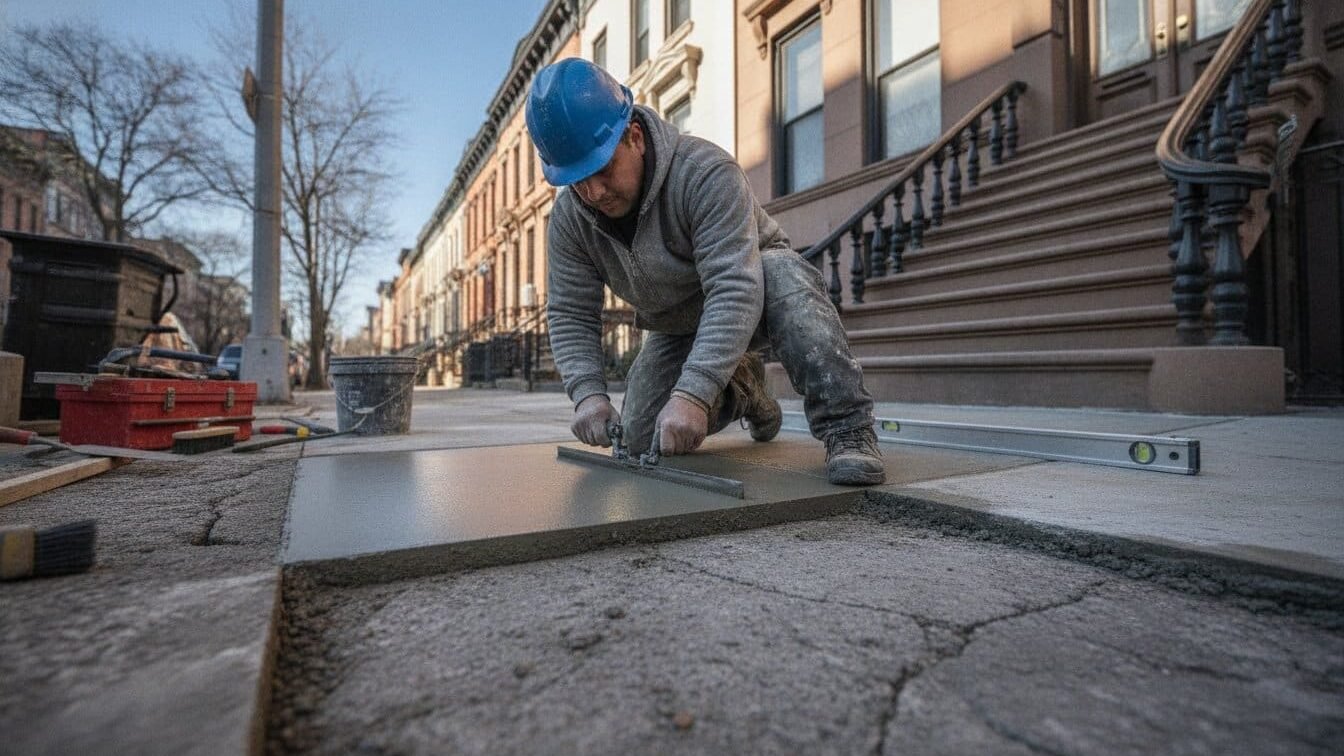
The standard for most NYC walkways is the 1-in-5 rule. This requires a minimum drop of 1 inch for every 5 feet of width. This specific ratio ensures adequate drainage without creating an uncomfortable incline for pedestrians. You should never exceed a 3-inch-in-5-foot threshold, as this triggers immediate non-compliance. You can check this on your own property by placing a 4-foot level perpendicular to your building. A compliant repair will show a clear, consistent gap between the level and the concrete as you move toward the curb, indicating a healthy pitch.
Corner and Intersection Treatments
Properties located on corners face double the scrutiny because they must align with legal grades from two different streets. These areas often require ADA-compliant pedestrian ramps featuring detectable warnings. These are the raised, truncated domes, usually in a contrasting color, that alert visually impaired pedestrians to the edge of the roadway. These ramps must be perfectly flush with the gutter to prevent tripping hazards. For complex or non-standard corners, the DOT often requires a specific sketch before work begins to ensure the NYC sidewalk repair specifications are met across both street fronts.

Historic Districts and Special Material Requirements
Owning property in a historic district adds a layer of complexity to exterior maintenance. You aren’t just following NYC sidewalk repair specifications; you’re also answering to the Landmarks Preservation Commission (LPC). In neighborhoods like Brooklyn Heights or the West Village, standard gray concrete is often prohibited. Instead, you might be required to use pigmented concrete. This specialized mix is darkened to mimic the weathered look of older pavements, ensuring that new repairs don’t clash with the historic character of the block. Failing to match these colors can result in a violation from both the DOT and the LPC.
For many landmarked streets, bluestone flagging is the mandatory material. These natural stone slabs offer a timeless aesthetic that defines New York’s oldest neighborhoods. Similarly, granite curbing is often required in place of standard steel-faced concrete. Granite is incredibly durable. It resists the corrosive effects of road salt and the physical impact of heavy vehicles better than almost any other material. While these materials are more expensive than concrete, they provide a level of resilience and character that modern materials cannot replicate.
Working within LPC Guidelines
Before you break ground in a historic zone, you must obtain a Certificate of Appropriateness from the LPC. This document confirms that your chosen materials and methods align with the district’s preservation goals. Attention to detail is vital during this process. You must match the custom scoring patterns and joint widths of surrounding properties to maintain a seamless look. Our deep experience in brick pointing NYC helps us understand these nuances, as matching historic mortar and stone textures is second nature to our masonry teams. This specialized knowledge, combined with our sidewalk repair expertise, ensures that your sidewalk repair is both legally compliant and aesthetically perfect.
Alternative Paving Materials
Some historic areas feature hexagonal asphalt pavers, which require a specialized, well-compacted sub-base to maintain their alignment over time. While these pavers are visually striking, they are more prone to weed growth and shifting than solid concrete flags. In high-traffic commercial zones, you might encounter granite blocks or large slabs designed for maximum longevity. While modern concrete is generally easier to maintain, historic bluestone requires periodic resetting to address the vertical displacements that naturally occur as the ground shifts. Proper maintenance of these premium materials protects your property’s value and its historic integrity.
If your property is located in a landmarked neighborhood, don’t risk a fine from multiple city agencies. Contact us for expert historic NYC sidewalk repair to ensure your restoration meets every regulatory standard while preserving the beauty of your investment.
Professional Execution and Sidewalk Violation Removal
Navigating the administrative side of a repair is just as critical as the masonry work itself. Even if your concrete meets every one of the NYC sidewalk repair specifications, the work won’t be recognized unless you’ve secured the proper “Permit to Repair Sidewalk.” This permit is your legal green light from the Department of Transportation. For a standard property, this permit currently costs $70 and covers up to 300 linear feet. If you own a corner property, you’ll need separate permits for each street front. Starting work without these documents can lead to additional fines and immediate work-stoppage orders from city inspectors.
Timing is everything when dealing with a Notice of Violation. While the city requires repairs to be completed within a 75-day window, we recommend initiating your response within the first 45 days. This proactive approach accounts for weather delays, permit processing, and contractor scheduling. If the 75-day deadline passes without a signed-off repair, the city may perform the work through its own contractors. This “City-Led” repair is often significantly more expensive and includes a mandatory 7% administrative fee. Hiring an experienced NYC sidewalk violation removal specialist ensures you stay ahead of these deadlines and avoid unnecessary costs.
The Permit and Inspection Workflow
The process begins with filing for the repair permit, which can be handled through the DOT’s online portal or in person. Once the permit is in hand and the site is prepared, you must notify the DOT at least 24 hours before you pour any concrete. This gives the city the opportunity to inspect the forms and the sub-base compaction. After the work is finished, you must request a final inspection. This is the only way to officially dismiss the violation from your property record. A successful inspection results in a “Dismissal of Violation” notice, which is essential if you plan to sell or refinance your property.
Choosing a Compliant Contractor
Not all masonry crews understand the nuances of city compliance. When selecting a partner, verify their licenses and insurance specifically for NYC street work. A qualified contractor handles more than just the concrete; they manage site safety, pedestrian detours, and debris removal. At Brick Tech Contracting Corp, we’ve been refining our approach since 1980. We view every project as a partnership, handling both the technical NYC sidewalk repair specifications and the complex paperwork required to clear your record. Our promise is built on 40 plus years of expertise, ensuring your property remains protected, compliant, and hazard-free for the long term across all five boroughs.
Secure Your Property with Expert Compliance
Mastering the technical details of NYC sidewalk repair specifications is the only way to ensure your property remains safe and violation-free. From the high-strength 4500 PSI concrete mix to the precise 1-in-5 slope for drainage, every measurement matters to city inspectors. Whether you’re maintaining a modern walkway or a historic bluestone entrance, following these guidelines protects your investment from harsh New York winters and legal liabilities. Precision in the planning stage prevents the need for costly re-work later.
Don’t let a Notice of Violation become a source of stress or lead to expensive city-led repairs. Since 1980, Brick Tech Contracting Corp has provided expert masonry and sidewalk services across all five boroughs. We are A+ rated for sidewalk violation removal and understand exactly how to navigate the city’s rigorous inspection standards. Our team handles both the structural repair and the necessary compliance paperwork, giving you total peace of mind throughout the process.
Get a Free NYC Sidewalk Repair Estimate from Brick Tech Contracting Corp to start your project with confidence. With the right technical approach and an experienced partner, you can enjoy a durable, compliant sidewalk that stands the test of time.
Frequently Asked Questions
How thick does an NYC sidewalk have to be?
Standard sidewalk flags must be at least 4 inches thick. If the sidewalk crosses a driveway or is subject to heavy vehicle traffic, the thickness requirement increases to 7 inches of reinforced concrete. These measurements ensure the walkway can support the intended load without cracking or sinking over time.
Can I repair just one cracked flag or do I have to replace the whole sidewalk?
You can replace individual flags rather than the entire sidewalk, but you must replace the full square. The DOT doesn’t allow patching, skimming, or filling cracks with mortar. Any repair that doesn’t involve a full-depth replacement of the affected flag will fail inspection and won’t clear an existing violation.
What happens if my sidewalk repair does not meet DOT specifications?
If your work fails to meet NYC sidewalk repair specifications, the DOT will refuse to dismiss the violation. You’ll be required to remove the non-compliant work and start over at your own expense. If the 75-day window expires before you complete a compliant repair, the city may perform the work and bill you at a significantly higher rate.
Do I need a permit for a small sidewalk repair in New York City?
Yes, you must obtain a “Permit to Repair Sidewalk” from the DOT before starting any work, regardless of the size of the repair. A standard permit costs $70 for up to 300 linear feet of sidewalk. Working without a permit is a serious offense that can lead to additional fines and immediate work-stoppage orders.
How long do I have to fix a sidewalk violation in NYC?
Property owners have exactly 75 days from the date a Notice of Violation is issued to complete the necessary repairs. It’s best to hire a contractor and pull your permits within the first 45 days to account for potential weather delays or material lead times. Missing this deadline often results in the city taking over the project and billing you for the costs.
What is the standard concrete PSI for NYC sidewalks in 2026?
The updated standard for 2026 requires a concrete mix with a minimum strength of 4500 PSI. This high-strength requirement is part of the NYC sidewalk repair specifications designed to withstand the city’s heavy pedestrian traffic and the corrosive effects of winter de-icing salts. Using a weaker mix will lead to premature spalling and surface failure.
Is a property owner liable for sidewalk slip-and-fall accidents in NYC?
Yes, property owners are legally responsible for the safety of the sidewalks adjacent to their property. Under NYC Administrative Code Section 19-152, you’re liable for injuries caused by sidewalk defects like trip hazards, vertical displacements, or ice accumulation. Maintaining your walkway in a safe, compliant condition is your best defense against these liability risks.
Does the city ever pay for sidewalk repairs?
The city rarely pays for repairs, but there’s a specific exception for damage caused by city-owned trees. Owners of one- to three-family homes can apply for the NYC Parks “Trees and Sidewalks” program. If the damage is verified to be tree-related, the city may cover the repair costs, though the waiting list for this program can be quite long.