When part of your building’s exterior fails, the material you rebuild with matters as much as the workmanship. Choosing between brick, concrete block, and natural stone affects how the repair looks, how it handles water and freezing weather, and whether it works well alongside the masonry that is already in place. For most NYC exterior repairs, the right answer starts with two simple questions: what is the wall made of now, and what job does it need to do?
New York City’s building stock makes this decision more nuanced than it first appears. A Brooklyn brownstone, a prewar Bronx apartment building, a Queens two-family home with a block rear wall, and a Staten Island property with a stone garden wall each call for different thinking. This guide compares brick vs block vs stone so you can have a more informed conversation with your contractor before any work begins.
Key Takeaways
- Start by identifying the existing material. In most exterior repairs, the best choice is the one that matches what is already there.
- Brick suits most NYC facades, parapets, and chimneys, but replacement units should be matched for size, color, texture, and absorption.
- Concrete block works well for foundations, backup walls, rear walls, and retaining walls, but it usually needs a protective finish when exposed to weather.
- Natural stone offers durability and character for steps, sills, bases, and historic fronts, though it is heavier and more specialized to install.
- Mortar must be compatible with the masonry units. A mortar that is too hard can cause damage to softer historic brick and stone.
- Landmarked buildings and properties in historic districts may need approval before changing or replacing visible materials.
How Each Material Shows Up on NYC Buildings
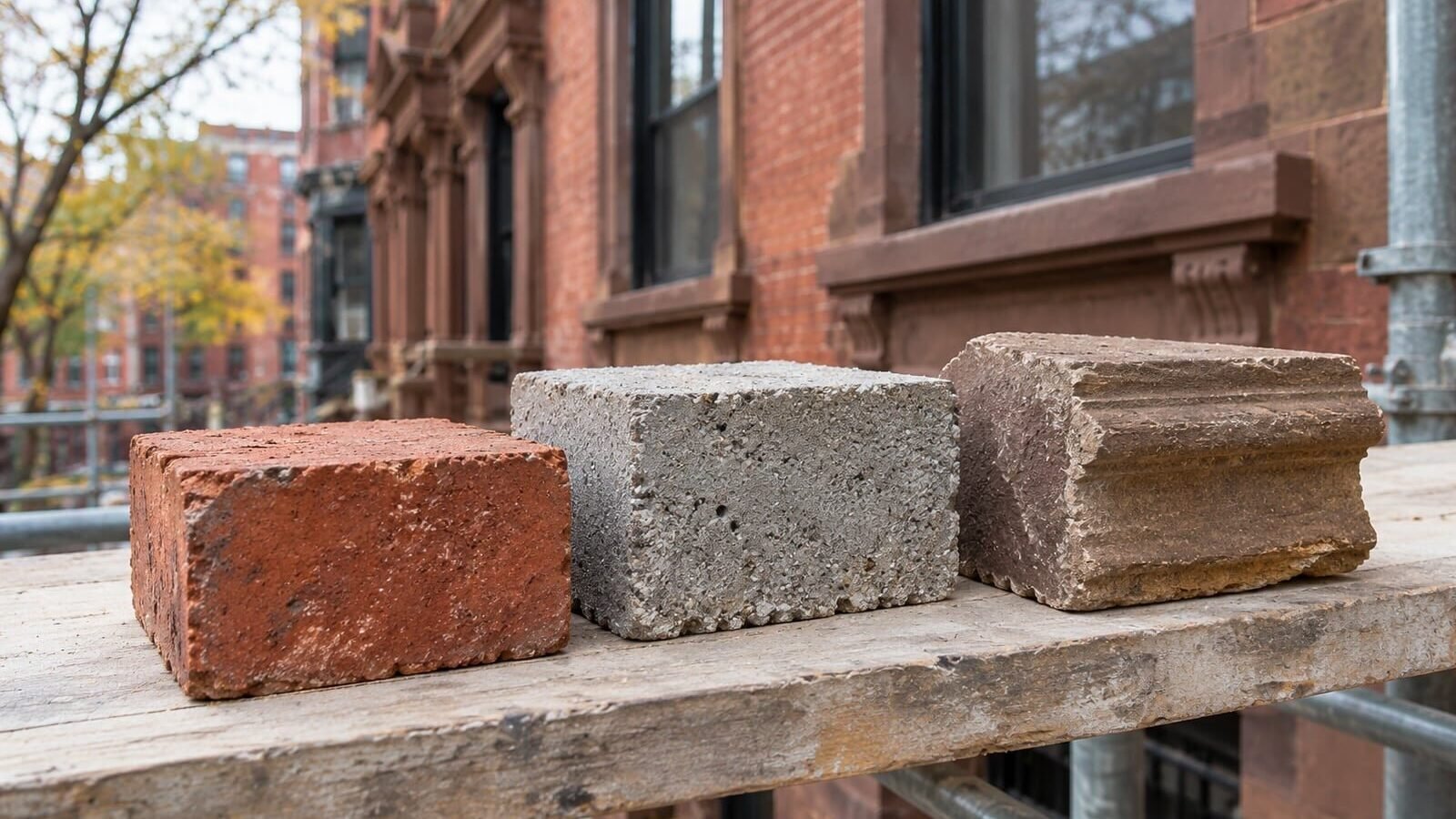
Before comparing performance, it helps to know where you are likely to find each material on a typical city property. Most buildings combine more than one, and a full masonry services assessment often reveals brick on the street side, block at the rear or below grade, and stone at the base, steps, or window openings.
Brick
Fired clay brick is the most familiar exterior material in the five boroughs. It appears on row houses, walk-up apartment buildings, commercial storefronts, parapets, and chimneys. Older buildings often contain softer, more variable brick than modern production units, and sizes can differ from today’s standard dimensions.
Concrete Block
Concrete masonry units, usually called CMU or simply block, are larger manufactured units made from cement and aggregate. In NYC they are common in foundations, backup walls behind brick, rear and side walls, garages, and retaining walls. Block goes up quickly, but its plain gray surface and porous nature mean it is usually finished with stucco, parging, or a coating when it faces the weather.
Natural Stone and Cast Stone
Natural stone on NYC buildings includes brownstone, limestone, granite, and bluestone. Brownstone is a sandstone found on many 19th-century row houses, while granite and bluestone are often used for steps, curbs, treads, and caps. Cast stone is a manufactured concrete product shaped and colored to resemble natural stone, and it is frequently used for sills, lintels, and trim replacements.
If you are unsure whether your project calls for brick-specific work or broader masonry repair, our article on brickwork vs. masonry repair in NYC explains how the two differ.

Comparing Brick, Block, and Stone at a Glance
Each material has strengths and trade-offs. The table below summarizes general characteristics, though actual performance depends on the specific product, installation quality, and how the wall manages water.
| Factor | Brick | Concrete Block (CMU) | Natural Stone |
|---|---|---|---|
| Typical appearance | Classic red, brown, or buff facade | Plain gray unless finished or faced | Distinctive texture and color, varies by stone type |
| Common NYC uses | Facades, parapets, chimneys, garden walls | Foundations, backup walls, rear walls, retaining walls | Stoops, steps, sills, lintels, bases, historic fronts |
| Weather exposure | Performs well when properly selected for exposure | Usually needs a finish or coating outdoors | Durability varies widely by stone type |
| Weight | Moderate | Moderate per wall area, larger units | Heaviest; may require structural review |
| Matching existing work | Good when units are carefully sourced | Rarely appropriate on visible historic facades | Often requires specialized sourcing or cast stone |
| Installation speed | Moderate | Generally faster due to larger units | Slower and more specialized |
Matching the Existing Wall Comes First
For repairs, the question is rarely which material is best in general. It is which material will perform alongside the original without creating new problems. Mixing materials in the same wall can lead to visible patches, uneven weathering, and stress at the joints where the old and new meet.
When a section of brick facade has failed, the usual approach is brick repair and replacement using units matched as closely as possible to the existing brick. A good match considers:
- Size: Older bricks may not match modern dimensions, which affects coursing and joint alignment.
- Color and texture: Even slight differences stand out on a street-facing wall.
- Hardness and absorption: A new brick that is much harder or less absorbent than its neighbors can change how water moves through the wall.
- Source: Salvaged brick can sometimes provide a closer match for older buildings than new production units.
Swapping in concrete block to fill a gap in a visible brick facade is generally a poor choice. Beyond the appearance, block and brick behave differently with moisture and temperature, and the mismatch can show up as cracking at the transition.
Why Compatibility Matters More Than Strength
Many owners assume the strongest, hardest material will last longest. With masonry, that assumption can backfire. Walls are designed so that the mortar joints, not the bricks or stones, absorb most of the stress and moisture movement over time.
The National Park Service’s guidance on repointing mortar joints in historic masonry explains that repointing mortar should be softer or more permeable than the masonry units it surrounds. When a hard, dense mortar is used with soft historic brick or brownstone, moisture and stress can be pushed into the masonry itself, contributing to cracking and spalling of the units.
This principle applies to replacement units too. The goal is a system where every component works together. Our guide to tuckpointing vs. repointing covers how joint work fits into a broader repair plan.
Where Each Material Typically Fits
Different parts of a property place different demands on masonry. This table outlines common choices for typical NYC repair areas. Your building’s existing conditions and any regulatory requirements should guide the final decision.
| Repair Area | Common Material Choice | Key Consideration |
|---|---|---|
| Street-facing brick facade | Matched brick | Appearance, absorption, and mortar compatibility |
| Parapet walls | Brick with stone or cast stone coping | Exposure on both sides and sealed coping joints |
| Foundation and below-grade walls | Concrete block or poured concrete | Waterproofing and drainage |
| Rear or side utility walls | Block or brick, depending on existing wall | Finish or coating if block is exposed |
| Retaining and garden walls | Block, brick, or stone | Drainage behind the wall and soil pressure |
| Stoops and steps | Brownstone, granite, bluestone, or brick | Slip resistance, salt exposure, and historic fit |
| Window sills and lintels | Natural stone or cast stone | Proper slope and water shedding |
Retaining walls and structural elements deserve special attention. Soil pressure and drainage behind the wall often matter more than the facing material, and these projects may require engineering input.
Weather, Water, and Freeze-Thaw Performance
New York winters bring repeated freezing and thawing, wind-driven rain, and road salt near sidewalks and stoops. Every masonry material absorbs some water, and how much it absorbs and how quickly it dries affects its long-term condition.
A few practical points:
- Brick for exterior use should be suitable for severe weathering exposure. Clay brick standards include grades intended for harsh climates, and a contractor can confirm that new units are appropriate for the location.
- Concrete block is porous, so exposed exterior block typically needs a finish, coating, or waterproofing to limit water entry.
- Stone performance depends on the type. Dense granite resists water well, while some sandstones, including brownstone, can delaminate when water gets behind their natural layers.
Regardless of material, good detailing makes the biggest difference. Sloped sills, sealed copings, working gutters, and sound joints keep water moving away from the wall.
Brownstone and Landmark Properties
Brownstone fronts deserve their own discussion because the stone is both character-defining and relatively soft. Damaged brownstone is commonly repaired by patching with a tinted repair mortar, by replacing units with natural stone, or in some cases by using cast stone. Each approach has different appearance, durability, and approval considerations.
If your building is an individual landmark or sits within a historic district, changes to visible exterior materials may require approval from the NYC Landmarks Preservation Commission before work starts. Replacing a brownstone stoop with a different material, for example, is the kind of change that may need review. Working with a team experienced in landmark restoration can help you plan the approval process alongside the repair.

What Drives the Cost of Each Option
There is no single price for brick, block, or stone work, because the material is only one part of the total. A repair on the third floor of a busy street-facing facade involves very different costs than the same material used on a ground-level garden wall.
Common cost drivers include:
- Building height and access, including scaffolding or sidewalk protection
- The size and location of the repair area
- Material sourcing, especially for matched brick or specialty stone
- Demolition and removal of failed masonry
- Structural repairs, such as steel lintels or wall ties
- Permits, approvals, and any required engineering
- Finishes, coatings, or waterproofing
Our breakdown of brickwork repair costs in NYC explains these factors in more detail. The most reliable way to compare options is a site-specific estimate based on an inspection.
Questions to Ask Before Approving a Material
Before you sign off on a repair, a few questions can reveal whether the proposed material is the right fit:
- What is the existing wall made of, and how will the new material match it?
- Is this element structural, or is it a facing or veneer?
- What mortar type will be used, and is it compatible with the existing masonry?
- Will exposed block or stone need a finish, coating, or sealer?
- Does the building require landmark approval or a Department of Buildings permit for this work?
- How will water be managed at sills, copings, and joints after the repair?
A contractor who can answer these clearly is far more likely to deliver a repair that blends in and holds up.
Frequently Asked Questions
Can I use concrete block to repair part of a brick wall?
It depends on the location. Block is commonly used in backup walls, foundations, and some rear walls, but it is usually a poor choice for patching a visible brick facade. The difference in appearance is obvious, and the two materials respond differently to moisture and temperature, which can lead to cracking where they meet.
Do replacement bricks need to be an exact match?
A perfect match is not always possible, especially on older buildings, but replacements should be as close as practical in size, color, texture, and absorption. Salvaged brick sometimes offers the best match for historic walls. On street-facing facades, careful matching helps the repair blend in and perform consistently with the surrounding masonry.
Is natural stone more durable than brick?
Not automatically. Granite is very dense and durable, while softer stones such as brownstone can weather and delaminate over time. Well-made brick suited to severe weather can also perform very well. Durability depends on the specific material, how it is installed, and how effectively the wall sheds water.
What is cast stone, and when is it a good option?
Cast stone is a manufactured concrete product made to resemble natural stone. It is often used to replace sills, lintels, copings, and decorative trim when matching natural stone is difficult to source. For landmarked buildings, using cast stone in place of natural stone may require approval, so check requirements before ordering materials.
Do I need approval to change the masonry material on my building?
If your building is an individual landmark or within a designated historic district, changes to visible exterior materials may require Landmarks Preservation Commission approval. Some masonry work may also require a Department of Buildings permit. Requirements vary by property and scope, so confirm what applies to your building before work begins.
Can a block wall be finished to look like brick or stone?
Yes, exposed block can be covered with stucco, a coating, or a thin brick or stone veneer, depending on the wall and its condition. The finish must be compatible with the block and detailed to manage water. Any veneer added to an existing wall should be evaluated for attachment and weight.
Conclusion
Choosing between brick, block, and stone is less about which material is best overall and more about which one suits your wall, its exposure, and the masonry already in place. Matching the existing construction, using compatible mortar, and detailing the repair to shed water are the factors that most often determine whether an exterior repair blends in and holds up through NYC winters.
Brick Tech Contracting Corp works with property owners across Manhattan, Brooklyn, Queens, the Bronx, and Staten Island on brickwork, brick pointing, brick repair and replacement, stoops, retaining walls, and landmark restoration. Our team can inspect your building, identify the existing materials, and recommend repair options suited to your property.
If you are planning an exterior masonry repair, contact Brick Tech Contracting Corp to schedule an inspection and request an estimate.